
Beaumont, TX & Southeast Texas
Water Heater Installation in Beaumont and Southeast Texas
Replacing a water heater is straightforward work that is easy to do badly, and most of what separates a good installation from a poor one is invisible once the panel is back on. We install tank water heaters across Southeast Texas, from Beaumont and the Golden Triangle out through Hardin County and along the Interstate 10 corridor. Sized correctly, connected to code, and set up so the next fifteen years are less eventful than the last ones.
How Water Heater Installation Works
Replacing a water heater is straightforward work that is easy to do badly, and most of what separates a good installation from a poor one is invisible once the panel is back on. We install tank water heaters across Southeast Texas, from Beaumont and the Golden Triangle out through Hardin County and along the Interstate 10 corridor. Sized correctly, connected to code, and set up so the next fifteen years are less eventful than the last ones.
Sizing, and the Question Nobody Asks
The default move is to replace what was there with the same thing. Sometimes that is right and often it is just what is easy. Capacity should follow the household as it is now, not as it was when the last heater went in. Bathrooms added, people added or moved out, a large soaking tub installed, a high demand shower fixture. Any of those change what the house actually needs. Recovery rate matters as much as tank size and gets less attention. A smaller tank with a strong recovery rate can outperform a larger tank with a weak one for a household that showers back to back in the morning. Total gallons is only half the number. Fuel type is worth revisiting rather than assuming. If gas is available and the existing unit is electric, that is a conversation, though it involves gas line work and venting. We would rather ask about the household than measure the old tank.
The Parts of the Install That Actually Matter
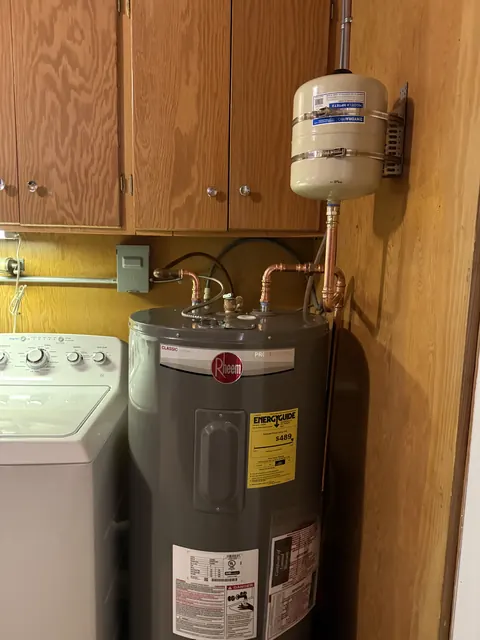
Venting, on a gas unit, is the one with real consequences. Combustion gases have to leave the building reliably. Vent connectors need proper rise, correct diameter, and secure connections. A vent that backdrafts puts combustion products into the house, and that is not a comfort issue. The temperature and pressure relief valve is a safety device, and its discharge line has to be routed correctly, to an appropriate termination, with no valve in it and no reduction in size. It is the component that stops a failed thermostat from becoming a serious event. Expansion. Many systems here have a check valve or pressure reducing valve that makes them closed, and a closed system with no expansion tank builds pressure every heating cycle with nowhere to put it. That stresses the tank and everything connected to it. Where the system needs an expansion tank, it gets one. Drain pan and drain line, particularly on interior installations. A tank will eventually leak, and where that water goes is decided at install time. Seismic and structural support is less of an issue here than elsewhere, but a heater on a raised platform or in an attic still needs proper support and a properly plumbed pan.
Local Installation Choices Worth Making
Two regional realities should influence how a heater goes in around here. The first is freeze. Uri froze supply lines to heaters in garages, unconditioned utility rooms and against exterior walls across the region. If your unit is in one of those positions, insulating the exposed lines properly during the install is cheap while everything is already apart and considerably less cheap afterward. The second is flooding. Harvey and Imelda put water into a great many buildings across the Gulf Coast, and a submerged gas water heater is a replacement rather than a repair, every time. On a property with flood history, raising the unit on a platform where the space permits is a decision that pays for itself the first time it matters. Neither is expensive at install time. Both are the sort of thing that only gets thought about once it is too late.
Hard Water and What Happens Next
The new heater is going onto the same water supply that finished the old one. Minerals in the regional supply settle in the tank and build a layer over the burner or around the lower element, which is what shortens tank life here. That starts on day one. So two things are worth doing. Flush the tank periodically, which is genuinely effective and almost universally skipped. And check the anode rod, which is a sacrificial component that protects the tank and is spent long before most people replace their heater. A heater that gets flushed and has its anode replaced once will outlast one that does not by a meaningful margin, on the same water, in the same house.
What Happens to the Old One
The removal is part of the job. Draining a tank full of sediment takes longer than draining a clean one, and getting a full sized heater out of an attic or a tight utility closet is frequently the hardest physical part of the day. We take the old unit with us. It does not sit in your driveway waiting for bulk pickup. And we test the installation before leaving. Gas connections checked for leaks, vent draft confirmed on a gas unit, relief valve verified, and the system brought up to temperature so the first hot shower is not the test.

Get a Free Water Heater Installation Estimate
Call (409) 834-3632 or fill out our form for a no-obligation quote.
Water Heater Installation Service Areas
We provide water heater installation services within 50 miles of Beaumont, including:
Common problems related to water heater installation
Related Services
Tankless Water Heater
Tankless installation, conversion, and descaling
Water Heater Repair
Diagnose and repair tank water heaters that leak, fail, or run cold
Residential Drain Cleaning
Clear slow and blocked drains in kitchens, baths, and laundry lines
Commercial Drain Cleaning
Scheduled and emergency drain service for restaurants, retail, and other businesses
Water Heater Installation We've Done
Water Heater Installation FAQ
What size water heater do I need?
Do I need an expansion tank?
Should I raise my water heater off the floor?
Can I install a water heater myself?

Ty Malagarie, Owner
N-Sink Plumbing and Drain Specialist · Est. 2026
Updated October 2026
Ready to Get Started?
Get a free, no-obligation estimate for your project.