

Beaumont, TX & Southeast Texas
Water Softeners and Filtration in Beaumont and Southeast Texas
Hard water leaves evidence. White crust on faucets, spots on glasses that never wash off, soap that will not lather, and a water heater that groans as it ages are all the same story. This page covers water softener installation, whole-house water filtration system installation, and drinking water filters at the sink. We work with homeowners and businesses across the Golden Triangle and the surrounding counties. The first step is figuring out what your water is actually doing to your house, because a softener, a filter, and a drinking water system solve different problems.
N-Sink Plumbing and Drain Specialist
Water Softeners and Filtration that transforms your property from the ground up.
Reading the Signs of Hard Water
Hard water carries dissolved calcium and magnesium. When water evaporates or heats, those minerals stay behind as scale. The evidence is easy to find if you know where to look. On fixtures, scale shows up as crusty white buildup around faucet aerators and showerheads, and as a film on glass shower doors. On dishes, it is spotting. In laundry, it is stiff towels and clothes that fade early. Inside the house, it clogs the aerators and reduces flow. The most expensive place it builds is in the water heater, where a layer of sediment forms on the bottom of the tank and on the heating surfaces, and the heater works harder and wears out sooner. It also shortens the life of dishwashers, washing machines, ice makers, and coffee makers. If appliances in your house seem to die earlier than they should, scale is a likely contributor. Hard municipal water is a familiar condition in this part of Southeast Texas, though the level varies by supply, so we do not guess. A test tells you what you are dealing with.
Water Softener Installation: What It Does and What It Does Not
A softener removes the minerals that make water hard by trading them for sodium or potassium in a resin bed, and it periodically flushes itself with brine. The result is water that does not scale pipes and fixtures, lathers well, and is gentler on the water heater. A water softener installation connects at the main water line where it enters the house, ahead of the water heater and the fixtures. It needs a bypass so water keeps flowing during service, a drain connection for the regeneration cycle, and a nearby electrical outlet. The location matters: a garage or utility closet works, a spot exposed to freezing does not. Winter Storm Uri showed how many outdoor and garage plumbing connections in this region were unprotected, and a softener's valves and drain line are as vulnerable as any other fitting. A softener does not purify water. It will not remove chlorine taste, sediment, or contaminants, and it is not a substitute for a filter. If a salesperson tells you it does everything, ask more questions.
Whole-House Filtration and Drinking Water Systems
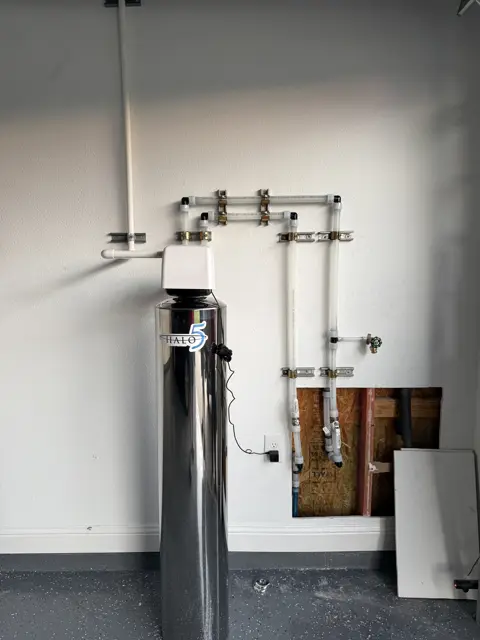
Filtration deals with what is in the water that is not hardness. A whole-house system treats everything entering the home. One example from our own work: we installed a Halo 5 whole-home water filtration system on the main water line of a home in Port Arthur. A sediment filter catches sand and rust particles, which matters in houses with older galvanized supply lines. A carbon filter reduces chlorine taste and odor. Both protect fixtures and appliances and make showers and laundry more pleasant. Under-sink drinking water filtration is a separate, smaller system. It treats the water you drink and cook with at one tap, and some versions use a dedicated faucet. It is a good fit if you like the whole-house water as it is but want better drinking water, or if you rent and cannot modify the main line. Municipal supplies across Jefferson County, Orange County, and Hardin County are regulated, and the Texas Commission on Environmental Quality (TCEQ) oversees drinking water standards. Private wells are a different matter, because no one is testing them for you. We do not service well pumps. If you are concerned about a specific contaminant, get a lab test first so any system is chosen for a real result.
Planning the Right System for Your House
We start with questions. How many people live there, how many bathrooms, where does water enter the house, and what are you trying to fix? Then we look at the space for equipment and the condition of the plumbing it connects to. Old piping that is corroding inside will not be helped by a softener, and in that case you may be better served looking at the repiping page. From Beaumont and Lumberton to Orange and Bridge City, we install, service, and replace these systems, and we are available around the clock if a leak develops. Free estimates are offered on all of it.
The N-Sink Plumbing and Drain Specialist Difference
Owner-Led
Ty Malagarie leads the team, not a call center dispatching strangers.
Local Knowledge
We know Southeast Texas plumbing, from Gulf Coast clay soil to hard-freeze winters.
Full Service
From diagnosis to final walkthrough, we handle every phase of your water softeners and filtration project.

Get a Free Water Softeners and Filtration Estimate
Call (409) 834-3632 or fill out our form for a no-obligation quote.
Water Softeners and Filtration Service Areas
We provide water softeners and filtration services within 50 miles of Beaumont, including:
Related Services
Residential Drain Cleaning
Clear slow and blocked drains in kitchens, baths, and laundry lines
Commercial Drain Cleaning
Scheduled and emergency drain service for restaurants, retail, and other businesses
Hydro Jetting
High pressure water jetting for grease, scale, and root-choked lines
Sewer Line Repair
Locate and repair broken, offset, and root-invaded sewer lines
Water Softeners and Filtration We've Done
Water Softeners and Filtration FAQ
How do I know if I need a water softener?
Is a softener the same as a water filter?
Do you install under-sink drinking water filters?
Will a softener help my water heater?
Can you install a softener in an older house?

Ty Malagarie, Owner
N-Sink Plumbing and Drain Specialist · Est. 2026
Updated October 2026
Ready to Get Started?
Get a free, no-obligation estimate for your project.